
The Jar Card
Mix the jar without opening the book. One page for the fridge door: 6-2-2-1 in cups and grams for a half jar, a full jar and a double, how to measure a cup, which binder goes in which recipe, and the numbers you look up most.
Included
For lifelong bakers whose gluten-free bread keeps coming out a brick

A gluten-free recipe is written for one flour blend: its author's. Bake it with the bag in your pantry and the dough changes, however carefully you measure. One-Jar Gluten-Free Baking ends the swap. You mix one blend, once, from four plain bags, and every dough and batter in the book is written for that jar, in cups and grams.
7-day money-back guarantee. If it is not for you, email us and we refund you in full. No forms.
One payment. No trial, no membership, nothing to cancel.
Why it came out a brick

You leveled every cup. You bought the good ingredients, watched the clock, and followed the recipe EXACTLY. A few hours later you turned out a loaf you could prop a door open with. Dense, gummy in the middle, crumbling under the knife.
And somewhere between the cooling rack and the trash can, you decided the problem was you. All those years of dinner rolls and birthday cakes, and one gluten-free loaf has you feeling like a beginner.
You are in a very large club. We read more than 10,000 reviews of gluten-free recipes and cookbooks, and one sentence kept coming back: "I followed it exactly." Among the low-rated recipe reviews, about one in five makes a point of saying the recipe was followed. And across the reviews, recipe comments and forum threads we went through, the question "what did I do wrong?" turned up 224 times (yes, we counted).
These are bakers writing about other gluten-free books and recipes, word for word:
"6 attempts at the white bread recipe...every time a fail. [...] I am an avid baker and have been baking for over 40 years. I am known for my baked goods."
"Another gluten free bread fail. I am beginning to think I am not meant to have gf bread what a waste of money and time."
"[...] have tried every bread book that has come out. They have all gone to the used book store."
It's the swap. Every gluten-free flour blend is a recipe of its own: which flours, how much starch, how much gum. Two bags that sit side by side on the shelf can differ on all three. A recipe is written for one of them. Bake it with another and the same cup weighs differently, drinks a different amount of water and brings its own dose of binder. Same pattern, different yarn, and the sweater comes out two sizes off. Nobody blames the knitter.
Cookies forgive a lot, which is how one bag can give you good cookies and a brick of a loaf. Bread forgives very little. It needs far more water and far more binder, so a small difference in the flour turns into a dense, gummy slice. One well-known cup-for-cup blend puts it in writing on its own product page: "best suited for non-yeasted recipes." Sandwich bread runs on yeast.
So you tried the usual ways out. The cup-for-cup bag did fine in cookies and muffins, then carried that same single dose of gum into your bread. Free recipes were often good ones, each written for its author's flour: twenty recipes, twenty swaps. And the serious bread books do work, if you are ready to stock a shelf of flours and weigh everything in grams (one reviewer counted "3 separate blends of flour" for a single white sandwich loaf). Which leaves the store-bought loaf at about $8, in small slices, better toasted.
Every brick costs you twice. Once at the register, because this flour costs real money. And once in the quiet afterwards, when you wonder whether your hands still know how to do this. They do. The recipe was written for one flour and baked with another.
So the fix sits one step before the recipe: settle the flour. One blend, the same on every page, so the recipe in front of you and the jar on your counter finally agree.
The One-Jar method
Here is the whole method. You measure four plain bags in whole cups, 6-2-2-1, whisk them together and pour the blend into a jar. From that day the flour question is closed: every dough and batter in the book is written for the jar on your counter, from the sandwich loaf to the last chocolate chip cookie. What one loaf teaches you still holds for the next.


What that does for you. One cup of the jar weighs 140 grams on every page, and the water in every dough and batter is written for what this flour drinks. So a lesson learned sticks: what one loaf teaches you holds for every bake after it, and you stop starting from zero with each new recipe. To try one bake before you fill the big jar, go to the No jar ready? box on the recipe page. It gives you the four flours for that single recipe.
Look inside
These are the pages exactly as they arrive in your inbox, each photo page with its recipe page beside it. Swipe through them and tap one to open it full size. Read every line: the amounts in cups and grams, the small gray reason under each step, the What went wrong box at the bottom of the bread pages. If these four read the way you like to bake, so does the rest of the book.
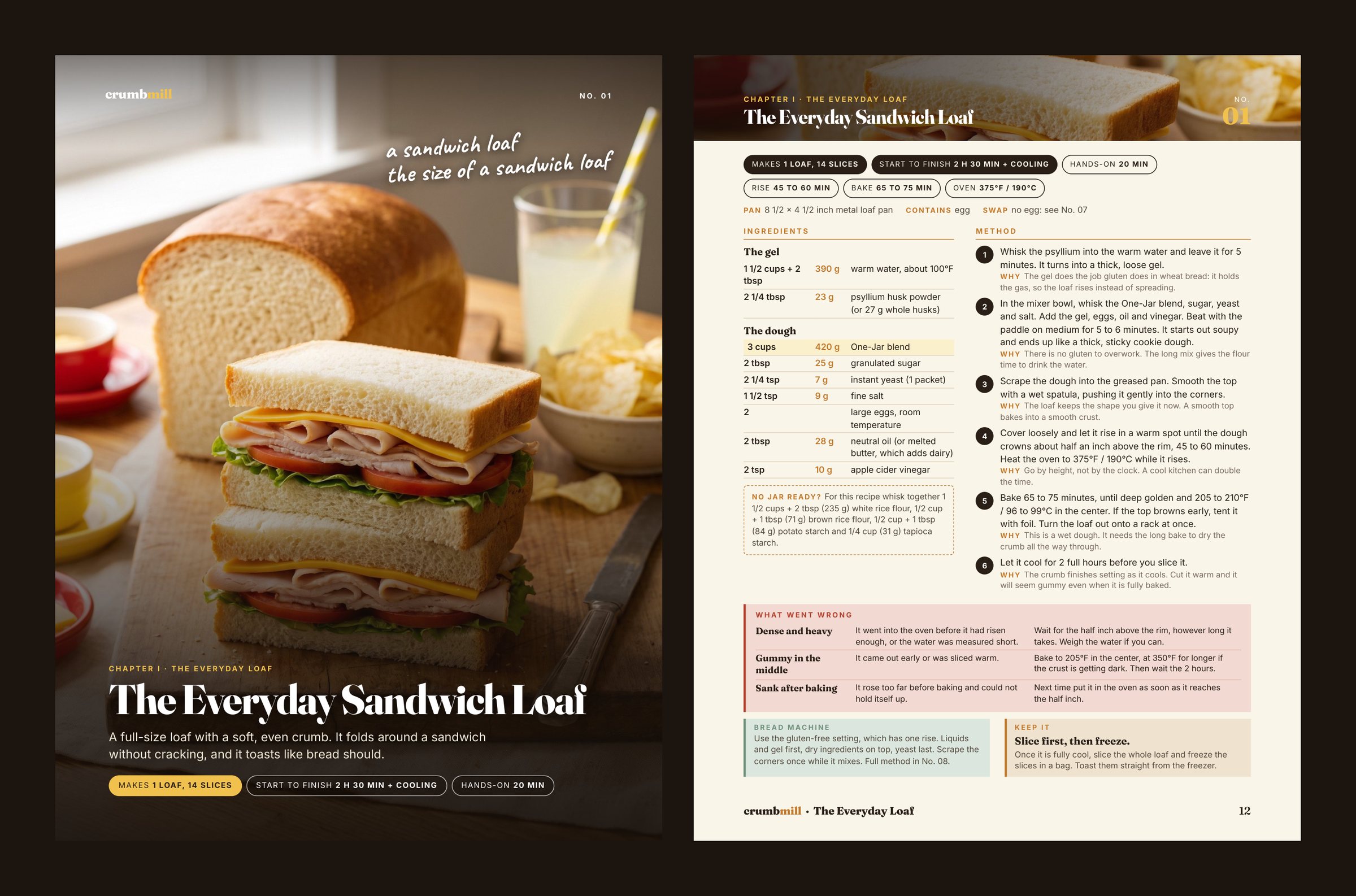
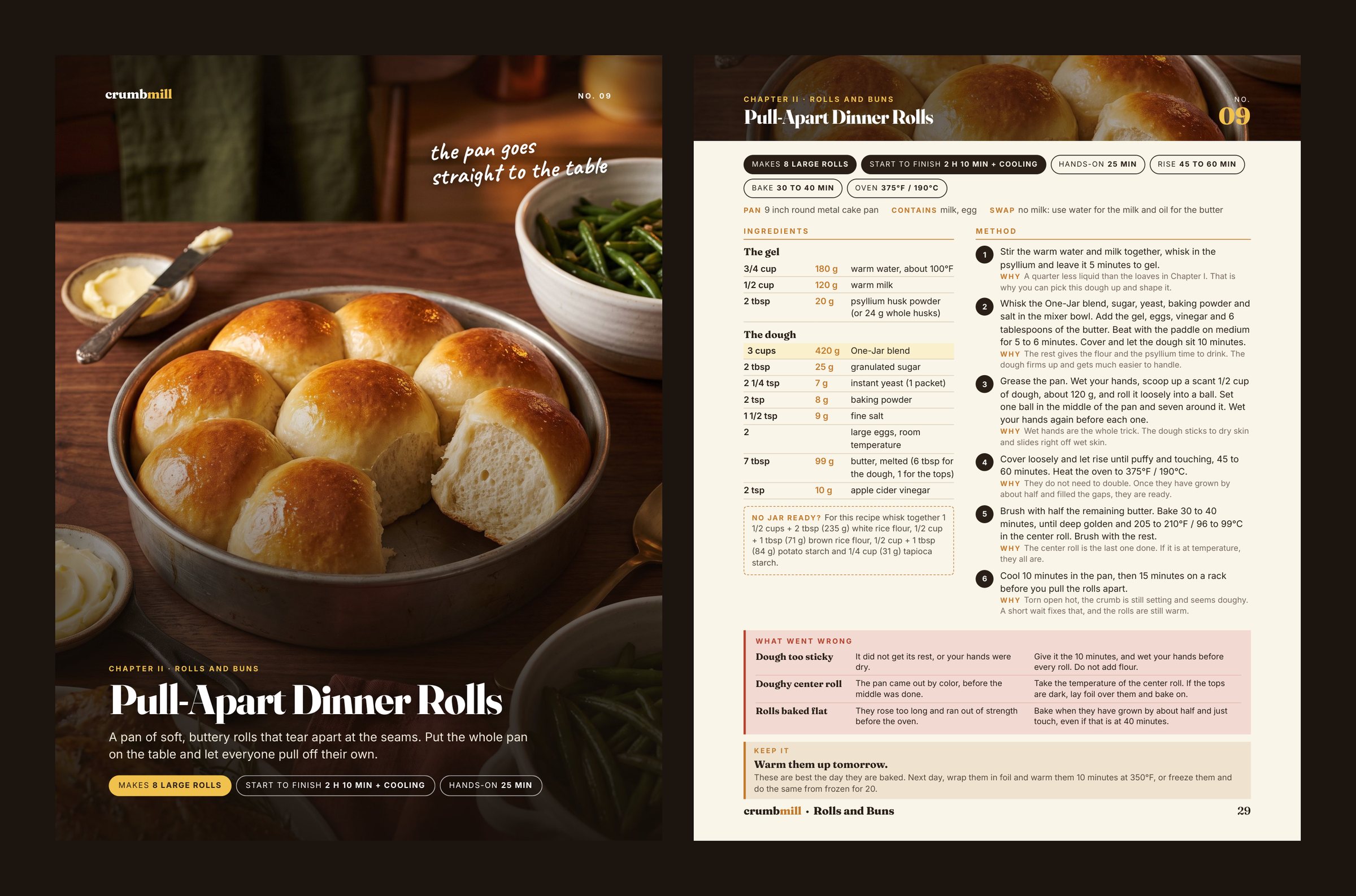
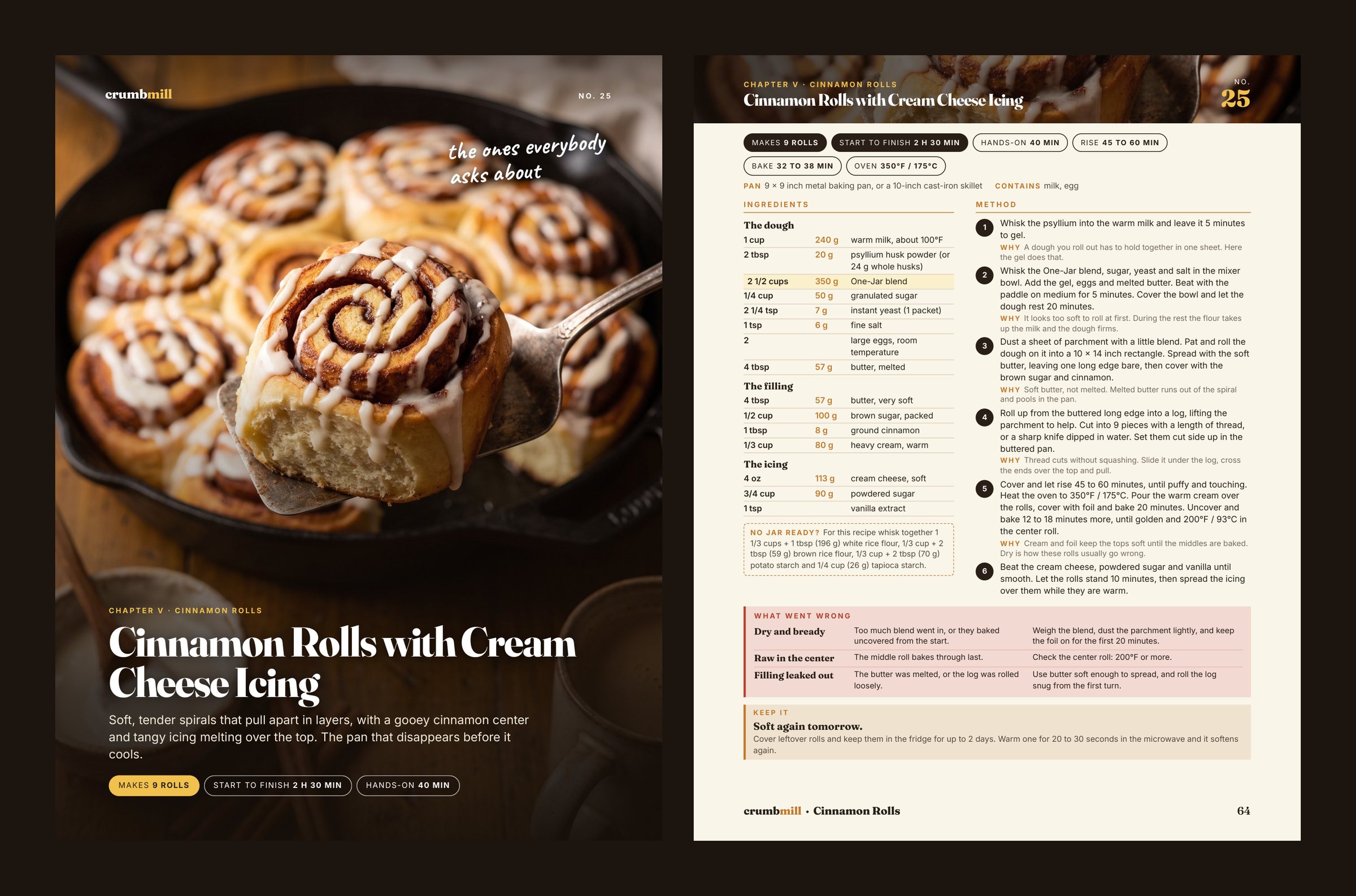
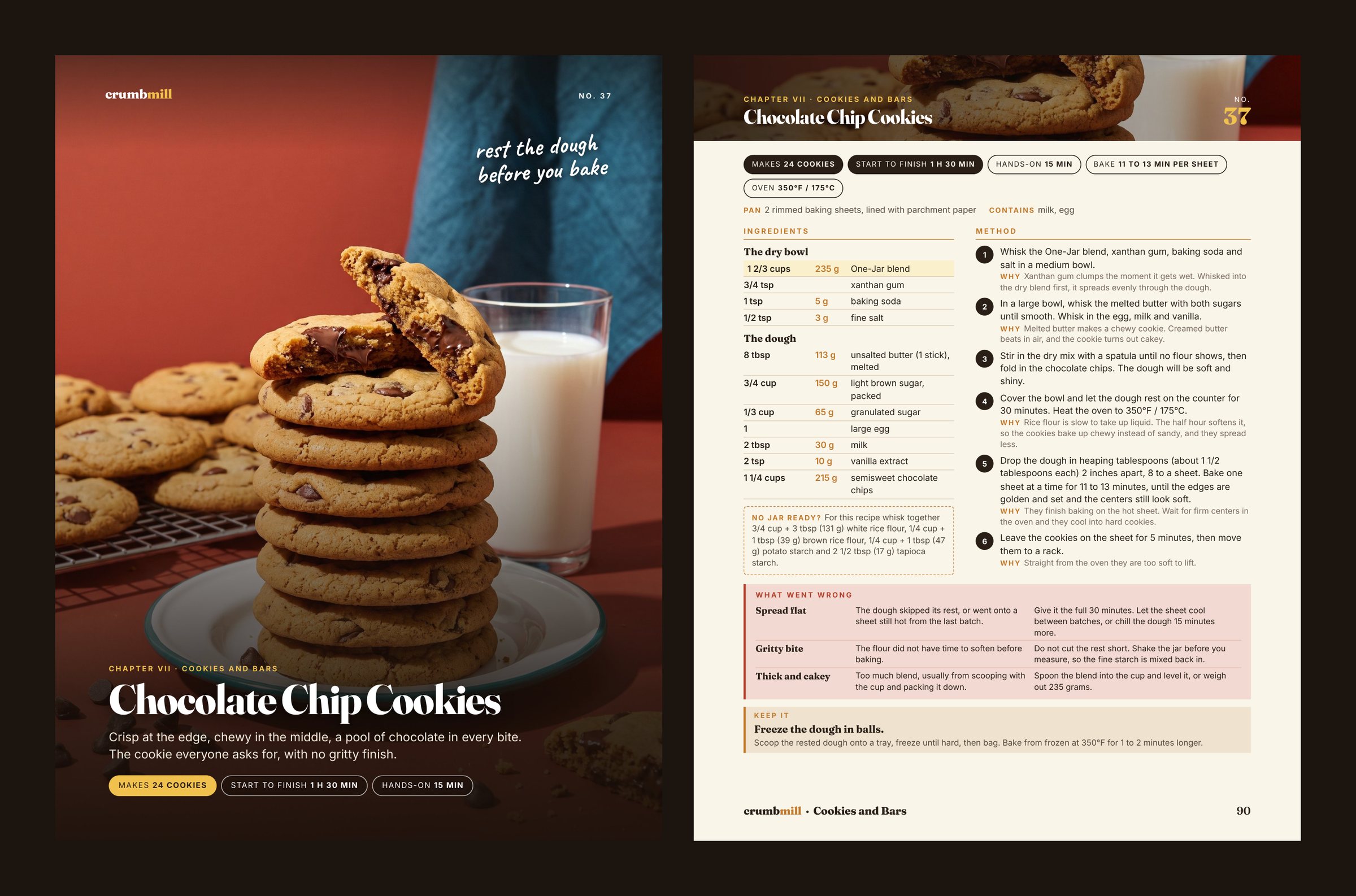
Swipe for more · tap a recipe to open it full size
What's inside

Chapter one is the everyday loaf: eight sandwich loaves, seven written for a standard 8 1/2 x 4 1/2 inch pan and one for the bread machine. Start with No. 01, which makes 14 slices and asks for 20 minutes of your own work. The rest is rising, baking and cooling. Then come the honey loaf, the seeded one, cinnamon raisin, a thick-slice toasting loaf, and one with no egg and no milk.

Hamburger buns and hot dog buns, pull-apart dinner rolls, sub rolls, English muffins and skillet flatbreads. Then the crusty chapter: a round loaf, an olive oil and herb loaf, two baguettes and a soda bread made without yeast. Bagels and soft pretzels round out the breads.

Cinnamon rolls with cream cheese icing, plus a make-ahead version: about an hour the evening before, the baking in the morning. And the rest of the weekend breakfast: pancakes, waffles, blueberry muffins, banana bread, buttermilk biscuits and cream scones.

Chocolate chip cookies, snickerdoodles, brownies and lemon bars. Snack cakes, vanilla and chocolate cupcakes, carrot cake, a lemon pound loaf and apple pie. The jar that made your bread makes these too: one blend to shop for, one blend on the shelf.
The Everyday Sandwich Loaf · Honey Sandwich Loaf · Soft Potato Sandwich Bread · Seeded Sandwich Loaf · Cinnamon Raisin Loaf · Thick-Slice Toasting Loaf · No-Egg, No-Milk Sandwich Loaf · Bread Machine Sandwich Loaf
Pull-Apart Dinner Rolls · Hamburger Buns · Hot Dog Buns · Sweet Slider Rolls · Sub Rolls · English Muffins · Soft Skillet Flatbreads · Garlic Butter Rolls
Everyday Crusty Round Loaf · Olive Oil and Herb Loaf · Two Baguettes · No-Yeast Soda Bread
Plain Bagels · Everything Bagels · Soft Pretzels · Buttery Crackers
Cinnamon Rolls with Cream Cheese Icing · Make-Ahead Cinnamon Rolls
Fluffy Pancakes · Crisp Waffles · Blueberry Muffins · Chocolate Chip Muffins · Banana Bread · Pumpkin Bread · Skillet Cornbread · Buttermilk Biscuits · Cream Scones · Crumb Coffee Cake
Chocolate Chip Cookies · Soft Sugar Cookies · Snickerdoodles · Peanut Butter Cookies · Double Chocolate Cookies · Butter Shortbread · Fudgy Brownies · Blondies · Lemon Bars · Jam Thumbprints
Vanilla Snack Cake · Chocolate Snack Cake · Carrot Cake · Lemon Pound Loaf · Vanilla Cupcakes · Chocolate Cupcakes · Vanilla and Chocolate Frosting · Flaky Pie Crust · Apple Pie · Berry Cobbler
Included with the book
Mix the jar without opening the book. One page for the fridge door: 6-2-2-1 in cups and grams for a half jar, a full jar and a double, how to measure a cup, which binder goes in which recipe, and the numbers you look up most.
Included

Read a disappointing bake in a minute. Find what you see in the left column (dense and heavy, gummy inside, sank in the middle, did not rise, crumbly slices), then read the likely cause and what to do next time. Eleven problems on one page, to keep by the oven.
Included

Read the recipe at the counter with one hand free. The whole book in pages sized for a phone screen, so your floury fingers have nothing to pinch and zoom.
Included

Keep the recipes you bake most in a binder. The same recipes with one recipe to a page: amounts and method, light on ink. The flour lands on paper and your tablet stays clean.
Included
How it works
Pay once through secure checkout by Stripe. A minute later the files are in your inbox: the book, the print and phone editions, the Jar Card and the What Went Wrong table.
Four plain bags, whole cups, your biggest bowl and a whisk. Whisk for a full minute, pour it into the jar, shake. A full jar is about 11 cups, enough for three Everyday Sandwich Loaves and a batch of chocolate chip cookies, and it keeps about three months in a cool cupboard.
Start with The Everyday Sandwich Loaf: 20 minutes of your own work, about 2 hours 30 minutes from bowl to rack, then 2 hours of cooling before the knife. The page tells you what to look for at each step, like the dough crowning half an inch above the rim of the pan. (The smell of bread in your kitchen is part of the deal.)
How this book is made
Every dough and batter is written for the jar at the front of the book, so you shop for one blend and store one blend. If the jar runs empty midweek, the No jar ready? box on the recipe page gives you the four flours for that one bake.
Every recipe in the book was baked in an ordinary American home kitchen, with a home oven and standard pans, before it went to print. The times, the cues and the temperatures on each page have been through a real bake.
New editions are yours free, waiting in your library. You pay once.

Everything you get today
Today$27
A store-bought gluten-free loaf runs about $8, the middle of the 145 prices we found people quoting. This book costs less than four of those loaves, and it is yours to keep. It arrives in minutes on your phone, tablet or computer. Read the phone edition at the counter, or print the recipes you bake most, as often as you like, for your own kitchen.
7-day money-back guarantee. If it is not for you, email us and we refund you in full. No forms.
Pay once. Nothing renews, nothing to cancel. Secure checkout by Stripe. Refund policy.
Email [email protected] within 7 days of purchase and we refund you in full. No forms, no questions about why, nothing to prove.
Questions
Free recipes can be very good. Each one is written for its author's flour, so twenty recipes means twenty swaps, and you find out whether your bag agrees at the end of a long afternoon. Here the flour is settled once: one blend for the whole book, everything in one place, and a What went wrong box on every bread page. Scroll up to Look inside and read four recipes in full before you decide.
Many good ones ask for several blends, or for a bag that is missing from your pantry, and leave the swap to you. This one is built the other way round: the flour comes before anything else, and every dough and batter is written for it. Every recipe was baked in a home kitchen before it was printed. Read the four recipes in Look inside. And if you change your mind, the 7-day guarantee covers you.
Every recipe in the book was baked in a home kitchen before it went to print, so the amounts, times and temperatures on the page have been through a real oven. Kitchens differ, though: a cool room, an old packet of yeast, an oven that runs hot. So every bread recipe ends with a What went wrong box: the three most likely problems with that loaf, the cause of each, and what to do next time. The recipes also give you something firmer than the clock to go by: how far the dough should rise before it bakes, and the temperature in the center when it is done.
The book is written for the jar. A ready-made blend carries its own starch and its own gum, so with it you are back to the swap, most of all in bread. Keep that bag for the recipes written for it, and mix the jar for this book. To try one recipe before mixing a full jar, the No jar ready? box on the page gives you the four flours for that single bake.
Four plain bags: white rice flour, brown rice flour, potato starch (look for the word starch) and tapioca starch, which is also sold as tapioca flour. Plus the two binders the recipes add: psyllium husk for the breads, a plant fiber often sold as a fiber supplement, and xanthan gum for cookies, cakes and muffins. Leave the ready-made blends for other books.
If you baked before going gluten-free, you can follow these pages. Amounts are in cups and spoons with grams beside them (the smallest, like a teaspoon of xanthan gum or baking soda, are by the spoon only), every oven setting is in Fahrenheit and Celsius, the pans are standard American sizes, and the line at the top of each recipe says how long it takes and how much of that is your own work. One thing will feel new: this bread dough is beaten like a thick batter, 5 to 6 minutes with the mixer paddle, and the recipe tells you why.
The Everyday Sandwich Loaf is about 2 hours 30 minutes from bowl to rack, and 20 minutes of that is your own work. The rest is rising and baking. Then it cools for 2 full hours before you slice it. The recipes are written to be made the same day, with one exception made on purpose: the Make-Ahead Cinnamon Rolls, split between the evening and the next morning.
For the sandwich loaves, an 8 1/2 x 4 1/2 inch metal loaf pan. The bread doughs are beaten for 5 to 6 minutes, which a stand mixer with the paddle makes easy; cookies, muffins and cakes need only a bowl and a hand mixer or a whisk. An instant-read thermometer helps with bread. One loaf has a bread machine version. And you can measure everything in cups: a scale earns its keep in the bread chapters, for the blend, the water and the psyllium.
It is one payment, once. Nothing renews. The book and every new edition stay in your library.
Yes. The print edition has one recipe to a page, so it is light on ink and fits a binder. Print the recipes you use, as often as you like, for your own kitchen.
Yes. The phone edition has the whole book with pages sized for a phone screen, so there is nothing to pinch and zoom at the counter.
Each recipe says whether it contains milk or egg, and gives a swap where one holds up. Where there is no swap, the recipe needs that ingredient. Chapter one has a sandwich loaf made with no egg and no milk. For every other allergen, your labels have the last word.
No, it is a PDF you download and keep. The full book is laid out on US Letter and reads well on a tablet or a computer. For paper there is the print edition, and for the phone the phone edition: both are included.
Then it costs you nothing. Email [email protected] within 7 days of purchase and we refund you in full. No forms, no questions about why. Full policy on the refund page.
No. This is a baking book, not medical or dietary advice. The recipes use ingredients that contain no gluten by nature, but flours, starches and many other products can pick up gluten where they are milled or packed. If you bake for someone with celiac disease or a wheat allergy, buy products labeled gluten-free, read every label every time, and follow the advice of your own doctor or dietitian. More on the disclaimer page.
Write to us and we replace it within 3 business days or refund you. Full policy on the refund page.
Try one more recipe with the bag in your pantry, and you find out at the end of the afternoon whether that recipe and that bag agree.
Settle for the frozen loaf, and it is about $8 a time, in small slices, for as long as you eat sandwiches.
Or mix one jar and bake from a book written for it, with every recipe tested in a home kitchen: every amount in cups and grams, the reason under each step, and a box on the page that tells you what to change when a loaf falls short. Thanksgiving is Thursday, November 26. Start the jar this month and the Pull-Apart Dinner Rolls (No. 09) are a recipe you already know by the time the table is set.
Take seven days with it. Change your mind, and one email gets you a full refund. Press the yellow button and the book is in your inbox in minutes.
7-day money-back guarantee. If it is not for you, email us and we refund you in full. No forms.
Only in this cart
These three volumes are written for the jar you are about to mix. Their price here is only in this cart. Tick what you want, then continue to payment: one checkout, one email, everything in it.
7-day money-back guarantee. If it is not for you, email us and we refund you in full. No forms.
Secure checkout by Stripe. Your files by email in minutes. One payment, yours to keep.